|
Protocol
for Antiobiotic Sensitivity Testing Using SYTOX® Green
1.
Introduction
The
Turner BioSystems TD-700 Laboratory Fluorometer in
combination with Molecular Probes' SYTOX®
Green nucleic acid stain provides a rapid and convenient
alternative to traditional methods for assessment
of bacterial sensitivity to antibiotics and a variety
of bactericidal agents. Established methods, such
as plate counts, disc diffusion plates, most probable
number (MPN) broth dilutions, or direct observation
based on sample turbidity, require incubation times
of 18-48 hours before results can be obtained. Methods
using fluorescent probes reduce the test-to-result
period and allow bacterial viability to be continually
monitored in real time. (1,2) SYTOX Green penetrates
damaged plasma membranes of dead bacteria (both gram-positive
and gram-negative), producing green fluorescent staining
of nucleic acids. Live bacteria with intact membranes
are unstained. This method for discriminating live
and dead bacteria has been successfully used to monitor
bactericidal action of disinfectants on Pseudomonas
and Staphylococcus bacteria.(3)
2.
Materials Required
- TD-700
Fluorometer with standard PMT and 10 mm x 10 mm square
cuvette adaptor (P/N 7000-009)
- Quartz-halogen
lamp (P/N 7000-930)
- 13
mm round test tube adapter (P/N 7000-981)
- 25
mm diameter optical filters for excitation at 485
± 11 nm, (Omega® Optical 485DF22) and emission at
530 ± 15 nm (Omega® Optical 530DF30), installed using
O-rings (P/N 7000-949).
- 13
mm x 100 mm borosilicate glass test tubes (P/N 10-031)
- SYTOX
Green nucleic acid stain (catalog number S-7020),
supplied by Molecular Probes, Inc., Eugene, OR. This
reagent is supplied as a 5 mM solution in DMSO in
units of 250 µL. One 250 µL unit is sufficient for
analysis of about 80 samples using this protocol.
Handling, storage and the use of the reagent should
be performed in accordance with the product information
sheet supplied by Molecular Probes, Inc.
- 5%
TSB/saline comprised of Tryptone (17 g/L), Soytone
(3 g/L), NaCl (5 g/L), K2HPO4
(2.5 g/L) pH 7.3 ± 0.2, available from Difco Laboratories
Inc.
- American
Type Culture Collection (ATCC) Preceptrol cultures:
Escherichia coli strains 25922 (sensitive) and 35218
(resistant).
- Ampicillin
(Sigma Chemical Co.)
3.
Experimental Protocol
3.1.
Bacterial Staining
3.1.1
Prepare suspensions of ampicillin-sensitive
and -resistant E. coli with densities of 2 X 10^7
cfu/mL in 5% TSB/saline (cfu = colony forming units).
3.1.2
Prepare 2X SYTOX Green staining solution by diluting
the 5 mM SYTOX Green/DMSO stock solution by a factor
of 1:500 in 5% TSB/saline, yielding a final dye
concentration of 10 µM. To prepare sufficient 2X
staining solution for analysis of 10 samples, add
30 µL of 5 mM SYTOX Green/DMSO to 15 mL of 5% TSB/saline.
3.1.3
Prepare a 200 µg/mL stock solution of ampicillin
in 2X SYTOX Green staining solution (step 3.1.2).
5 mL of this stock solution is sufficient for the
measurements specified in this protocol.
3.1.4
Prepare dilutions of the ampicillin stock solution
to concentrations of 2 µg/mL, 20 µg/mL and 60 µg/mL
by addition of further 2X SYTOX Green staining solution
(step 3.1.2).
3.1.5
Label a set of 5 glass test tubes "Resistant"
and a second set of 5 tubes "Sensitive". Label one
member of each set of tubes with the following designations:
Reagent blank, 1, 10, 30 and 100 µg/mL ampicillin.
3.1.6
Transfer 1.5 mL of TSB/saline/2X SYTOX Green (step
3.1.2) to each reagent blank test tube and make
up to 3 mL total volume by adding a further 1.5
mL TSB/saline.
3.1.7
Transfer 1.5 mL of 2 µg/mL, 20 µg/mL, 60 µg/mL and
200 µg/mL ampicillin in 2X SYTOX Green staining
solution (steps 3.1.3 and 3.1.4) to the tubes labeled
1, 10, 30 and 100 µg/mL ampicillin, respectively.
3.1.8
Transfer 1.5 mL of the resistant E. coli suspension
(step 3.1.1) to each of the 4 ampicillin-containing
test tubes labeled "Resistant".
3.1.9
Transfer 1.5 mL of the sensitive E. coli suspension
(step 3.1.1) to each of the 4 ampicillin-containing
test tubes labeled "Sensitive".
3.1.10
Incubate all samples at 37° C for 1 hour prior to
carrying out fluorescence measurements.
3.2
Fluorescence Measurements
3.2.1
Set-up TD-700 with a quartz halogen lamp, Omega
Optical 485DF22 excitation filter, and Omega Optical
530DF30 emission filter.
3.2.2
Calibrate in the Simple Mode according to section
VII of the TD-700 Manual using the sample from the
antibiotic-sensitive set that contains the highest
concentration of ampicillin (100 µg/mL) as the calibration
standard. This sample should be the most fluorescent
among those to be measured.
3.2.3
Read the "Sensitive" and "Resistant" samples in
the order of reagent blank followed by the bacterial
samples in order of increasing ampicillin concentration.
3.2.4
For each sample, record the fluorescence intensity
value shown on the fluorometer display screen. To
equalize any photobleaching effects, insert samples
into the fluorometer for approximately equal time
periods. The data may be corrected for the dye background
by subtracting the reagent blank fluorescence value
from bacterial sample fluorescence readings.
3.2.5
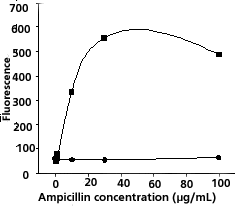
Plotted data should show increasing fluorescence
as a function of ampicillin concentration for antibiotic-sensitive
bacteria in contrast to relatively constant low
fluorescence for antibiotic-resistant bacteria (Figure
1).

4.
References
- FEMS
Microbiology Lett 133, 1 © 1995.
- J
Antimicrobial Chemotherapy 34, 613 © 1994.
- J
Appl Bacteriol 81, 411 © 1996.
5.
Patent & Trademark Information
SYTOX
is a registered trademark of Molecular Probes, Inc.
SYTOX® Green nucleic acid stain is covered
by current or pending U.S. and foreign patents.
6.
About Molecular Probes
Orders
for Molecular Probes' products may be placed by:
Phone:
(541) 465-8338 or Toll-Free (800) 438-2209 in the
U.S. and Canada
Fax: (541) 344-6504 or Toll-Free (800) 438-0228
in the U.S. and Canada
Email: order@probes.com
Mail: Molecular Probes, Inc., PO Box 22010, Eugene,
OR 97402-0469, USA
Information
on the scientific and technical background of Molecular
Probes' products is available from the Technical Assistance
Department by:
Phone:
(541) 465-8353
Fax: (541) 465-4593
Email: tech@probes.com
Internet: http://www.probes.com
7.
About Turner Biosystems, Inc.
Orders
for Turner BioSystems' products may be placed by:
Phone:
(408) 749-0994
Fax: (408) 749-0998
E-mail:
sales@turnerbiosystems.com
Internet: www.turnerbiosystems.com
Mailing
Address:
Turner BioSystems, Inc.
845 W. Maude Avenue
Sunnyvale, CA 94085
|
